
Is Brick Bad For Your Building

Chris White • June 11, 2026

Share this article

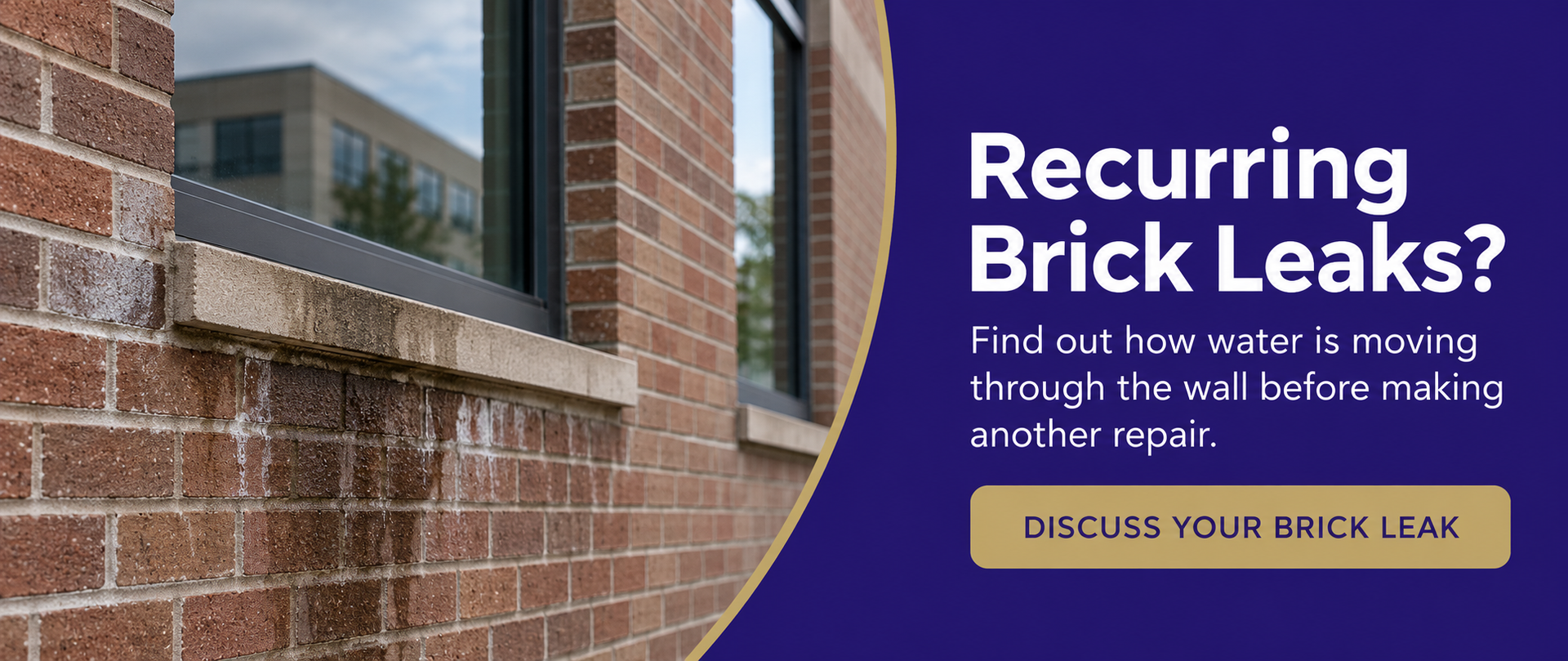
Brick leaks!

Why

Brick is a relatively new building material. It’s only been in use for about 9,000 years.

We’ve graduated from full brick walls to brick veneer walls—and started the bulk of our brick problems.

Having said that, brick is really good stuff.

So why do some new brick buildings have problems now

Well, it seems that we’ve forgotten what our grandfathers knew. We changed how we installed brick by putting it on steel or wood framing. That’s different but not necessarily the kiss of death.

Sometimes what looks like full brick is almost synthetic stucco (think of flat tile being glued to a wall). That’s different as well but not necessarily the kiss of death.

Sometimes brick is considered the sole protective weather barrier—not as an integral part of the cladding system, but as the only protective system. And this is almost always the kiss of death.


What should you do if your brick leaks

First, you may be surprised to learn that free water will drain down the back of your brick veneer within a minute of being exposed to running water (I call that rain)—so water is entering the field of the wall. The key is to get it out of the wall before it goes indoors.

In all likelihood, water is getting indoors at improperly flashed roof to wall connections, improperly flashed openings (like windows, doors, dryer vent exhaust, tv cable entry) (Why do we punch holes in perfectly good walls? Answer, because we have to.) You can remove the brick in those areas, properly flash and prepare the openings, and repair the brick.


Did you know that the masonry subcontractor sometimes builds bridges into the brick veneer wall

If your wall is leaking at the bridges, you must have the bridges removed.

What is a bridge? Bridges can be mortar or windows or doors or vent penetrations. We often find a build-up of mortar either on the brick ties or at brick ledges that block the air space between the brick and the weather resistive barrier. Shoot, the bridge can become a dam too—if water can’t get to the weep hole—it is dammed!

The bridges are a way for the water that runs down the brick (that’s where we want the water to be) to get to the inside. No bridges or dams and water won’t get indoors.

While repairing, if you find structural damage because of the water intrusion, you’ll have to replace the damaged materials.


What to watch for

Well, you bought a brick cladding system to begin with—how do you know you’ll get a proper system the second go around? That is the $64,000 question.


You may not have picked up on it, but I have used the word system throughout the discussion above. Brick is an important part of the cladding system and it has to be tied in with the water barrier. If you screw up the water barrier, it doesn’t matter what you use for cladding. Note, there are other parts to the cladding system.


What should you do for a building you plan to construct

Make sure your architect designs and your masonry contractor constructs proper flashing, horizontal/vertical expansion joints, and includes a mock-up of the construction (test the mock-up and photograph each stage of the successful construction—1 in 4 adults cannot read—so comic book style word pictures will help you get a successful system).


Brick is not bad for buildings

I like brick. It is pretty, durable, and nearly maintenance free. But the entire cladding system has to be designed and built properly.

If you want someone to look over the shoulder of your architect or contractor, or if you need help reviewing or designing a cladding system, or if you have questions or comments, send me an email. Also, I’d appreciate any photographs you have of failing brick or of successful brick repair projects.

Wynn

P.S. Email me if you’d like me to email you our idea of a near perfect commercial brick veneer wall.


Recent Posts

Environmental Engineering Consultants in Louisiana
By Chris White August 2, 2026
Learn what Louisiana school districts should evaluate for asbestos, mold, moisture, lead paint and indoor air quality before renovating older schools.
By Chris White July 17, 2026
Imagine you’re sitting in your office when you notice a drip-drip-drip. You get the trash can out and put it under the leak-problem solved! Or is it? Does that water touch anything that supports mold growth, like the gypsum board ceiling or your ceiling tile? Do you notice odors after it rains? Do you notice dark fuzzy stuff around the leak or on your air conditioning vents? Mold might not be the end all bad stuff that some folks make it out to be. But if you or someone else notices it-it must be an aggravation at the very least-and it is causing pain of some sort, so let’s stop it, clean it up, and keep it from coming back. Just taking the time to talk about mold is hurting your productivity and there are known health affects of mold-let’s leave that topic for another day. Ten Things You Should Know About Mold: 1. Potential health effects and symptoms associated with mold exposures include allergic reactions, asthma, and other respiratory complaints. 2. There is no practical way to eliminate all mold and mold spores in the indoor environment; the way to control indoor mold growth is to control moisture. 3. If mold is a problem in your building, you must clean up the mold and eliminate sources of moisture. 4. Fix the source of the water problem or leak to prevent mold growth. 5. Reduce indoor humidity to decrease mold growth. 6. Clean and dry any damp or wet building materials and furnishings within 24-48 hours to prevent mold growth. 7. Clean mold off hard surfaces with water and detergent, and dry completely. 8. Prevent condensation. 9. In areas where there is a perpetual moisture problem, do not install carpeting. 10. Did I say stop the moisture? What to do if you have mold: 1. Stop the moisture (and keep it from coming back). 2. Clean up the mold (may require demolition). 3. Develop and implement a proactive moisture management plan. Do you need a professional engineer to design the remediation and repairs? As professional engineers, we are trained to analyze and find the cause of the problem, identify and evaluate the pros and cons of options, and offer you the solution that best fits your goals. This is the basis for design. We, as engineers, spend countless hours searching for options, learning about solutions, investigating products, and trying to understand the available technologies. We have long detailed conversations with experts on subjects like air sealing, water management, egress, health and safety, wind loads, indoor air quality, and structural loads. What to look for if you need professional help: A registered Professional Engineer who has 20 years in the industry and is experienced in solving mold related issues. Look for someone the experts call when they have a question-or when they’re too busy and they want to be sure their clients are taken care of. Someone who has a clear and well defined process that’s going to keep you informed and educated throughout the project so that you know what’s happening throughout each step and you have all the documentation to help eliminate or mitigate any future litigation you may encounter. Leave a comment or question below and I’ll send you a copy of a Proactive Moisture and Mold Management Program that you can use to help you avoid mold problems. Stay moldy, my friends. Chris White, P.E., LEED AP has been helping clients solve problems for 20 years. He is the Most Interesting Engineer in the World. You can follow him on Twitter @ChrisWhitePE .
By Chris White July 14, 2026
Why does stucco leak water into buildings? We get many calls about stucco and water intrusion. I have one friend (he develops buildings) who hates stucco. Why Stucco has been around for a long time. Think of the beautiful stucco structures that are over 100 years old. The stucco was used initially on full masonry walls. It helps shed water and in some cases provided a sacrificial protective service. Really good stuff. So why is it a problem now Well, today it’s used it on materials different from masonry. We put it on steel or wood framing. That’s different but not necessarily the kiss of death. Sometimes what looks like stucco is synthetic stucco or nontraditional stucco (I think of stucco being a three coat system). That’s different as well but not necessarily the kiss of death. Sometimes stucco is considered the sole protective weather barrier—not as an integral part of the cladding system, but as the only protective system. And this is almost always the kiss of death. What should I do if my stucco leaks First, find out where the water is entering the structure. Is it entering through the field of the stucco, at roof to wall connections (think of balconies as a mini-roof), or at openings (windows, doors, cable entrances, etc.)? If water is entering through the field of the stucco, you have a real problem. You’ll probably have to replace all of the stucco. If water is entering roof to wall connections or openings, you can remove the stucco in those areas, properly flash and prepare the openings, and repair the stucco. If you find structural damage because of the water intrusion, you’ll have to replace the damaged materials. What to watch for Well, you bought a stucco cladding system to begin with—how do you know you’ll get a proper system the second go around? That is the $64,000 question. You may not have picked up on it, but I have used the word system throughout the discussion above. Stucco is an important part of the cladding system and it has to be tied in with the water barrier. If you screw up the water barrier, it doesn’t matter what you use for cladding. Note, there are other parts to the cladding system. Stucco is not bad for buildings I like stucco. It is pretty, durable, and nearly maintenance free. But the entire cladding system has to be designed and built properly. If you need help reviewing or designing a cladding system or if you have questions or comments, send me an email. Also, I’d appreciate any photographs you have of failing stucco or of successful stucco repair projects.
By Chris White July 14, 2026
If you’re like me and not in the path of Hurricane Laura, you’ve spent a good bit of time watching Hurricane Laura news coverage. So far it looks like the surge wasn’t nearly as bad as predicted, but Hurricane Laura caused a tremendous amount of damage to Cameron and Calcasieu parishes and the surrounding areas. It’s also too soon to tell how much damage Hurricane Laura will cause as the storm moves inland and dissipates. What’s certain though, is Hurricane Laura will leave a considerable amount of water damage, resulting in water damage restoration and mold remediation. Hurricane Laura environmental cleanup is going to be a huge undertaking and will cause disturbance of asbestos, lead, PCB, and mercury. Proper removal and disposal of those materials is super important. Typically, storm coverage emphasizes water damage and mold remediation. Water damage restoration and mold remediation after Hurricane Laura will be the most obvious cleanup and restoration tasks. But everyone involved with Hurricane Laura environmental cleanup has to consider the other environmental hazards they could encounter. Hurricane Laura environmental cleanup will take time. Response work, particularly environmental cleanup, must balance speediness and caution. This is particularly important since we’ll want to get out right away and assess damage as soon as Hurricane Laura clears out. I know everyone wants to get in and get everything cleaned up and put back together. When we went through Hurricane Gustav (and other storms over the years), I was the same way. But sometimes hasty cleanup efforts can make more of a mess if we don’t slow down and assess all the potential environmental hazards in the work area. We may also put ourselves, co-workers, friends, and family at risk if we unknowingly create an environmental problem. Your safety is the most important consideration. Whether it’s water in the roadways, downed power lines, unstable structures, or contaminated water, make sure it’s safe to move around before you try to get in and assess the damage and environmental hazards. And when the storm is over, we often see hot temperatures return. Dehydration, heat exhaustion, and heat stroke are common problems people face. You’re stressed out and exhausted, and now you’re working in the heat, trying to put your home or business back together. Take care of yourself, then worry about contents – it’s worth repeating that you can always replace buildings and contents, but not people. You can replace buildings and contents, but not people. I won’t get too far into avoiding mold and mold remediation, other than to stress that you need to get the building clean and dry. Maybe Hurricane Laura is the only cause of the mold. Or maybe there’s an ongoing moisture problem that existed before the storm, and now the recovery work has led to discovery of other moisture problems. Find the cause, get the building dried out, cleaned up, and keep the mold from coming back. One other quick reminder on water damage restoration and mold remediation: there is no such thing as a Mold Free Certificate . There’s no requirement to get your home or building certified as “mold free” to make sure you can sell or rent a home or building. Anyone trying to sell you a mold free certificate is trying to scam you. Period. 

By Chris White June 15, 2026
We have had some questions on cleaning and disinfecting facilities for coronavirus (COVID-19). We have worked to prepare specifications building owners can give contractors to clean and disinfect facilities for coronavirus. In particular, these specifications include cleaning and disinfecting HVAC systems for coronavirus. Obviously, the coronavirus pandemic is unlike anything we’ve experienced. This is not like a flood, hurricane, earthquake, or any other natural disaster we’ve faced. The other virus scares we’ve had in recent years haven’t come close to this. And since coronavirus is invisible and very difficult to detect (at least in comparison to the kind of environmental sampling we typically do), cleaning and disinfecting facilities for coronavirus is not like mold remediation or asbestos abatement. Instead of quickly firing out specifications for cleaning and disinfecting for coronavirus, Wynn and I spent a good bit of time thinking through the process, including surface cleaning and disinfection, HVAC system cleaning and disinfection, and finally, how to verify successful cleaning and disinfection of coronavirus. So it’s taken us some time to get the specifications together. Add to that what we don’t know about coronavirus: how long it can survive on different surfaces and in certain conditions, how temperature and relative humidity affect coronavirus, on and on. We’ve done our best to come up with a thorough cleaning and disinfection specification, but something pretty much any restoration or environmental contractor can execute. Compared to our other specifications, like for mold and asbestos, these specifications are much shorter, while still containing good information to protect the contractor, building occupants, and get the job done. We got to thinking about the places or surfaces where coronavirus could survive, as well as the risk for building occupants from high touch surfaces or ways to spread coronavirus through the air. Surface cleaning and disinfection for coronavirus is obvious. But there could be areas we haven’t yet considered. It got us to thinking about a place or system every building has: the HVAC ductwork and coils. It turns out coronavirus likes cold, wet places. Well, what’s one place that’s cold and wet in our buildings? That’s right – the air conditioner coil, or HVAC system coil. Whatever term you use. When we run our air conditioners, the HVAC coil stays cold and wet. Since coronavirus can get into the air, it can get into the HVAC system, and from there, to the coil. So there’s a ready made spot for coronavirus to survive, even if the building is totally abandoned. Unless we totally abandon a building and shut off the air conditioners, there’s a chance coronavirus could survive past what we think is a safe period. Here’s a quick rundown of what’s included in the specifications, and our thinking for how to go about cleaning and disinfecting facilities for coronavirus: First, the specifications require a thorough cleaning and disinfection of surfaces and materials. No magic here – a thorough cleaning using one of the materials listed with the EPA for cleaning and disinfecting coronavirus . Second, building owners may want to consider cleaning and disinfecting HVAC systems for coronavirus. This includes the ductwork and the coils. For other microbiological contaminants like mold, often duct and coil cleaning is not necessary. There’s also the inconvenient fact that as soon as you open the building and turn the HVAC system back on, mold gets back into the ductwork and rest of the HVAC system since mold is everywhere. So we aren’t against cleaning ductwork and HVAC system coils, but it’s more often than not more related to the Owner’s risk tolerance for mold. Since coronavirus likes cold, wet places, and we are assuming people aren’t going to shut down their HVAC systems for a month, we recommend cleaning and disinfecting ductwork and HVAC coils for coronavirus. If you’re going to spend all that time and money cleaning and disinfecting surfaces and contents, we think it’s a good idea to consider cleaning your ductwork and coils. Third, the specifications cover how workers protect themselves while cleaning and disinfecting for coronavirus. This includes use of protective clothing, gloves, goggles, and respirators. The specifications contain procedures for workers to clean themselves before and after going into the coronavirus cleanup work area. Last, the specifications cover how to conduct testing to verify if the contractor cleaned and disinfected successfully. Unfortunately, there’s no ready-made coronavirus test that is commercially available for environmental testing, at least right now. And rightly so, any commercial lab that can analyze samples for coronavirus is going to be busy analyzing tests for people. So how would we measure success, or at least guess at it? What we’ve settled on for now is a combination of verification used for different facilities such as surgical suites, food preparation, and other public areas. For surfaces, we’re suggesting use of Adenosine Triphosphate (ATP). For HVAC system testing, we’re suggesting using gravimetric testing and analysis. Building owners should decide what criteria they want to set for successful completion. As we get further into this or find other alternatives, we’ll update these recommendations. If you’re interested in more information or would like to get a set of the COVID-19 Cleaning and Disinfection Specifications, click the link below. In case you missed it, here’s a link to the Indoor Environmental Quality Podcast Episode 8 where I cover Ready.gov and OSHA information on coronavirus. If you’d like more information, email me . Or visit our website www.wynnwhite.com or you can find me on Twitter and Instagram: @chriswhitepe The Indoor Environmental Quality Podcast is available in iTunes (if you’re still running the old school iTunes application!), Apple Podcasts app, Google Play, iHeart Radio, and Spotify.
By Chris White June 10, 2026
If current projections hold, Tropical Storm Marco will make landfall along the Louisiana coast, followed soon after by Hurricane Laura. Environmental hazard remediation after Tropical Storm Marco and Hurricane Laura will involve mold remediation and water damage restoration. That’s a given. But there are other environmental hazards often present in our homes and buildings – asbestos, lead, PCB, and mercury. Typically, storm coverage emphasizes mold remediation. I get it – mold remediation has been a hot topic for years now, and will continue to be, especially every time we have a tropical storm or hurricane. But everyone involved with environmental hazard remediation and recovery has to consider the other environmental cleanup hazards they could encounter. Environmental hazard remediation after tropical storms takes time. Response work, particularly environmental cleanup, must balance speediness and caution. This is particularly important this week since we’ll want to get out and assess damage as soon as Tropical Storm Marco clears out. But here’s the problem: Hurricane Laura is going to make landfall right about the time that’s happening. Not the best time to get out and take a look at what recovery is needed since Hurricane Laura may cause more damage. I know everyone wants to get in and get everything cleaned up and put back together. But sometimes hasty cleanup efforts can make more of a mess if we don’t slow down and assess all the potential environmental hazards in the work area. My advice may not make much sense, and I know from my own experience that you want to get things fixed and back to normal as soon as possible. Things may feel (or literally are) upside down after tropical storms. Especially this week when we are going to take a hit from two storms almost literally back to back. Remember though, your safety is the most important consideration. Whether it’s water in the roadways, downed power lines, unstable structures, or contaminated water, make sure it’s safe to move around before you try to get in and assess the damage and environmental hazards. And when the storm is over, we often see hot temperatures return. Dehydration, heat exhaustion, and heat stroke are common problems. Take care of yourself, then worry about contents – it’s worth repeating that you can always replace buildings and contents, but not people. You can replace buildings and contents, but not people. I won’t get too far into avoiding mold and mold remediation, other than to link to our other blog posts on avoiding mold . The important thing to remember is to determine the cause of the water or moisture problem that caused the mold. Maybe the tropical storm or hurricane was the only cause of the mold. Or maybe there’s an ongoing moisture problem that existed before the storm. Find the cause, get the building dried out, cleaned up, and keep the mold from coming back. One other quick reminder on water damage restoration and mold remediation: there is no such thing as a Mold Free Certificate . There’s no requirement to get your home or building certified as “mold free” to make sure you can sell or rent a home or building. Anyone trying to sell you a mold free certificate is trying to scam you. Period. Don’t waste your money. Back to environmental hazard remediation. Tropical Storm Marco and Hurricane Laura are probably going to bring about a lot of renovation and demolition work that will disturb asbestos and lead. Don’t get so focused on mold that you ignore other hazards.
By Chris White June 9, 2026
On March 21, 2025 Joe “Radio Joe” Hughes and Cliff “Z-Man” Zlotnik had Chris White on IAQ Radio to cover a wide range of indoor air quality and environmental topics, ranging from asbestos abatement, lead, mold and moisture, and storm recovery and response.
By Chris White May 21, 2026
It’s almost time for 2026 baseball. I don’t know about you, but I’m excited for Spring Training and college baseball to get going. It is no coincidence that mold season runs concurrently with the Major League Baseball season, typically from the start of Spring Training through the end of the World Series. Building HVAC systems work harder to manage moisture during this period. Add in some storms, leaks, or any other moisture issues, and we’re off chasing mold and moisture problems. In the world of facility management, mold and moisture recurrence is a theme we see far too often. As the legendary Cub Ernie Banks used to say, “Let’s play two!”—but in our industry, no one wants to play a mold remediation double header. Repeating remediation is a costly error that involves unnecessary aggravation, time, and money. Mold problems frequently return if the initial cleanup only addresses the visible growth without correcting the underlying moisture source that caused the issue in the first place.
By Chris White May 13, 2026
This year, resolve to Commission all of your projects I hope your 2015 is off to a great start. Instead of asking you about your personal to-do list for 2015 (or worse, share mine), I thought I’d share an idea for a New Year’s Resolution that can help your projects move along. Project commissioning can help improve project performance. You may have seen past blog posts on how Building Commissioning can help project teams successfully execute projects. Building Commissioning can keep costs down (over the long haul), reduce overall project time, improve communication, and in general make the Owner or Client happier than they may otherwise have been, since Building Commissioning projects involve the novel concept of defining the Owner’s Project Requirements (OPR) . Ok, fine. But what if you’re not involved in Building Commissioning projects? I respectfully submit that if you’re involved in any kind of design, construction, renovation, demolition, or environmental sampling project, Owner’s Project Requirements (OPR) matter a great deal. Or if you’d like, change OPR to Client’s Project Requirements (CPR). It’s extremely important to define success on every project – no matter the size. Start by asking the person who’s paying the bill for exactly what they want. I’m not a mind reader, and plowing ahead on a project without defining the client’s project goals can punch you in the mouth. Ask me how I know. Even if you do everything you said you would, you may end up with an unhappy client. Once you discover your client is unhappy, you’ll try to fix the situation, but you may wind up unhappy, even if the client winds up satisfied. For you Owners out there, do you want unhappy consultants, design professionals, and contractors? I doubt it. Before I go further, I want to be clear on one thing – I’m not finding fault with design professionals, contractors, or Owners/Clients here. We all have a part to play in good (or hopefully not, bad) communication. And sometimes not communicating, even if no one’s to blame, can lead to unhappiness for some or all of the project team. Not good. project commissioning can help you avoid being Force choked by your client, or your boss Let me lay out a common scenario that plays out at our office: a contractor calls up asking for exposure monitoring for asbestos or lead. After asking for air sampling for the particular analyte, they usually stop talking. That’s when my vast experience kicks in, and I start asking a bunch of questions to find out where and when the work will happen, how many samples we need to collect, reporting requirements – all the information I need to do my job. Hopefully, this results in my delivering a comprehensive proposal, I win the project, we do a good job, and the client gets what they need and are happy. And they hire us again. But what if I don’t ask something important, and I wind up not taking enough samples, or delivering the final report after the client wants it? This is bad enough on a one-day sampling job, but if this happens on a large, long duration project, this could be bad for all involved. Even though this may not seem to apply to you, I bet you see how this can apply to any project. I hope you consider Commissioning all of your projects – regardless of type, and you develop and implement a process that allows you to define the OPR or CPR (whatever you wind up calling it). I mean, the U.S. Navy commissions ships and submarines, even though they’ve built a ton of vessels. If it’s good enough for the U.S. Navy, it’s probably good for our projects too, right? Are you or your project team currently involved in Building Commissioning projects, or do you have a process for Commissioning projects, regardless of type? Please share your story in the comments section. Stay resolved, my friends. Contact me for a free tip sheet with ideas for Building Commissioning, or for ideas on developing a Commissioning procedure for your projects. Chris White, P.E., LEED AP, CBCP has been helping clients solve problems for 20 years. He is the most interesting engineer in the world, and is a LEED Accredited Professional and Certified Building Commissioning Professional (CBCP). You can follow him on Twitter @ChrisWhitePE .
By Chris White May 13, 2026
How do I stop acting like an engineer and transition to thinking like an Owner? I find myself in a very strange position – I’m building a house, which is great for all the reasons you’d be excited about building a house. But it’s also a little unsettling, because I’m used to being the engineer or consultant, not the Owner. So how do I stop thinking like an engineer and more like an Owner? Maybe that’s a question better left unanswered. We’re not too far along in the project, but I’ve come to appreciate the Owner’s perspective a little more. For one thing, you’re peppered with questions at the beginning and along the way (at least I hope you Owners are). I mean, if you’re paying to have something built (or you’re the Owner’s representative), you have to live with the decisions, and hopefully you’re asked for input before the work starts. Luckily for us, the decisions so far have only involved some colors and finishes. Our family’s decision making process involves more than one person, as is usually the case when a family builds a home, and I’m reminded of how project teams have to make key decisions after (hopefully) reaching consensus. Some things, like certain finish colors, don’t matter that much to me, but hey, I’m not too much of an aesthetics guy. I’ve largely managed to avoid going “all engineer” on our contractor, so I don’t think I’ve driven him crazy yet. Or at least he hasn’t said so, which is just as good. The other thing is trust – there’s a certain amount of trust we place in each other, whether you’re the Owner trusting the design team and builders, or having faith that things are going well. But there remains a certain amount of “but verify” that follows the “trust” part. A great example is the plan set we have – pretty good as far as drawings go, but there are some missing details, that left unexplained, could lead to problems down the road. A good example is flashing and penetration preparation details. There are none on our drawing set. There are a lot of construction related items that will rely on the builder’s knowledge and the workmanship of his direct employees and subcontractors. Knowing what I know, and seeing problems like I have, this is a bit outside my comfort zone. So how do we make sure things get done correctly, if at all? Or is ignorance bliss? The real answer is probably yes and no. I’ve visited the site pretty frequently, partly because I’m excited, and partly because there are certain construction details I want to make sure are correctly installed, like the window openings, drainage planes, and flashing. I’ve seen how construction defects can cause disputes (and worse – unhappy families and litigation!), and also mold and moisture problems. Sometimes it’s fun to work on those projects, but I have yet to see an Owner that’s thrilled to have construction defects, mold, or moisture problems. How do I make sure I communicate the Owner’s Project Requirements to the Contractor, so the job meets my OPR? This brings to mind some of our recent blog posts – especially the ones dealing with determining the Owner’s Project Requirements (OPR). As an engineer, I want to make sure the projects meet my client’s expectations, and so we work to develop and meet the OPR. Having said that, now I’m the Owner, and you better believe I want the project to meet the OPR! So in some ways I have to do twice as much thinking (dangerous) – I need to think of important issues/problems I want to solve or avoid, and at the same time effectively communicate with the Contractor. The good news is the Contractor is a very well respected and accomplished contractor, so this hasn’t been an issue. In fact, this Contractor has his own way of determining the OPR (although he doesn’t call it that). He’s taken steps to make sure there’s a pretty good overall flow in the process, while allowing adequate time for decisions and discussing options. For you Owners out there, I understand a little better how you probably feel about your projects – a mixture of excitement and apprehension. So far it’s been a lot of fun. I hope your projects involve more fun for you this year. Developing and meeting the Owner’s Project Requirements can help make the job more fun. Or hopefully a little less stressful. Stay hopeful, my friends. Contact me for a free tip sheet for helping your projects meet the Owner’s Project Requirements. Chris White, P.E., LEED AP, CBCP has been helping clients solve problems for 20 years. He is the most interesting engineer in the world, and is a LEED Accredited Professional and Certified Building Commissioning Professional (CBCP). You can follow him on Twitter @ChrisWhitePE .
Show More